How US Google results are structured (and why strategy matters)
In many US industries the first screen is a mix of AI answers, ads, local results, and rich features. Winning in the USA usually means earning visibility across the layers that buyers actually interact with — not only “a blue link”.
Illustration (not a benchmark): in the US, visibility is often split across AI, ads, local, and organic layers.
What this changes for strategy
US search behavior is practical: people compare, check reviews, and want proof fast. We plan SEO around intent and the SERP layout, then build the smallest set of pages that can win first.
- AI overview: “answer-ready” content, entities, and clean structured data.
- Ads: landing pages + message testing that feeds SEO priorities.
- Map pack: local trust signals (profile, reviews, consistency, local links).
- PAA: objections and pre‑sale questions turned into FAQs and modules.
- Organic: high‑intent pages reinforced by relevant links and mentions.
Competitive landscape in US SERPs (what you’re really up against)
“SEO in the USA” is not one problem — it depends on the SERP pattern for your keywords. Below are common landscapes we see across US markets and the strategy we typically start with to earn visibility without publishing thin pages.
Practical takeaway
Instead of creating dozens of state pages upfront, we usually start with a smaller set of high‑intent pages and a few priority states. Once the system works (rankings + conversions), we scale into more states with unique content modules and a documented link plan.
What our SEO agency delivers in the USA
The deliverables below are designed for US competition: clear intent mapping, clean technical foundations, and authority building that does not rely on risky shortcuts. Whether you are targeting a single location or multiple states, the system stays the same: diagnose, prioritize, execute, measure.
Technical SEO and site cleanup
Indexing, templates, internal linking, speed, and structured data — so Google can crawl and understand the site correctly.
- Crawl/indexation audit + fix list
- Template improvements (titles, canonicals, headings)
- Core Web Vitals and mobile performance
US intent-driven content strategy
We map search intent by service, state/location, and purchase stage, then produce briefs and pages that convert.
- Service pages, location pages, and comparison pages
- Topic clusters and internal linking
- FAQ and proof blocks (reviews, cases, credibility)
Link building that supports rankings
We earn relevant mentions and links. No spam blasts. No generic link packages. Everything is documented.
- Local and niche resources
- Partnership, supplier, and association links
- Editorial PR-style placements when relevant
Competition & SERP features
Why US results feel crowded
Many US queries show ads, directories, and rich results above the fold. We start with high‑intent pages that can win sooner, then expand into broader topic coverage.
- Prioritize “service + pricing + comparison” intent
- Improve CTR with titles/snippets + structured data
- Strengthen landing pages with proof blocks and clear CTAs
Trust signals that compound
Reviews, citations, and brand mentions
In the US, trust is a ranking and conversion factor. We keep your signals consistent across the web and build authority with relevant links and mentions — documented and auditable.
- Google Business Profile + review strategy (for local)
- Clean citations / NAP consistency where applicable
- Relevant links and mentions (no spam footprints)
Content that sells, not filler
Depth + clarity + real differentiation
US users compare providers. Content needs clear offers, proof, and answers to objections — not “SEO text”. We build pages people can trust and understand quickly.
- Service pages with scannable structure + proof
- Comparison and “best option” pages where appropriate
- FAQ blocks that match real pre‑sale questions
How buyers describe SEO help in the USA
Keywords are useful for mapping intent, but we don’t write pages as keyword dumps. Instead we translate common USA searches into a plan: what to build, what to fix, and what to measure.
Starting broad, then narrowing
Most teams begin with a broad search like USA seo agency, USA seo company, or USA seo services when they want a partner to own the work. If they prefer a single specialist, the phrasing shifts to USA seo consultant or USA seo expert.
Some buyers start even higher in the funnel with USA digital marketing agency or USA digital marketing company, then narrow to SEO once the acquisition mix and priorities are clear.
“Best” vs “affordable” intent
Shortlists tend to include searches like USA best seo agency, USA best seo company, or USA best seo consultant. Those queries usually mean: “show proof, explain your process, and make reporting clear.”
Budget-led teams search USA affordable seo services, USA affordable seo agency, or USA affordable seo company. We keep scope lean with prioritization and fast shipping — not shortcuts that create clean-up later.
Local & “near me” demand
For map pack visibility and local lead flow, people look for USA local seo agency, USA local seo company, or USA local seo services. On mobile this becomes USA seo near me or USA local seo near me.
If the buyer wants a person rather than a firm, you’ll see USA seo consultant near me or USA seo expert near me. We translate that intent into concrete work: Business Profile, reviews, location pages, and local authority.
Deliverables behind the wording
USA seo audit usually means “find what is blocking growth and give us a plan.” USA keyword research defines what pages you should build and how buyers phrase intent.
USA on-page seo covers page structure, internal links, copy clarity, and schema. USA seo optimization is the ongoing loop of shipping improvements and measuring impact.
US SEO playbook: foundation → pages → authority
The United States is a huge search market and it is rarely “one-size-fits-all”. Rankings are shaped by SERP features, aggressive competitors, and trust expectations that vary by industry. Our playbook stays consistent: build a clean technical base, publish high‑intent pages that convert, then earn authority with relevant links and mentions.
What makes SEO in the USA different
US buyers tend to compare options quickly. Rankings alone are not enough — pages need clarity, proof, and a reason to choose you. That is why Rankuity operates as both an SEO agency and a link building agency: we improve your site and we build authority around it.
- SERP crowding: ads, directories, and rich results push organic down.
- Trust first: reviews, consistent business information, and credible mentions matter.
- Scaling structure: state hubs prevent duplicate content when expanding nationally.
- Conversion matters: intent match + page UX decide whether traffic becomes leads.
If you already have an in‑house SEO team, we can plug in on link building only. If you want end‑to‑end execution, we run the full growth system.
Local SEO (single location)
For local businesses we optimize Google Business Profile, local landing pages, reviews, and local links that support map pack visibility.
- GBP optimization + categories + services
- Review velocity + response process
- Local citations and cleanup where needed
Multi‑location / multi‑state
For brands expanding across the US we build scalable architecture: state hubs first, then roll out location pages without duplication.
- State hubs + internal linking logic
- Unique content framework per market
- Centralized reporting by state and service line
National SEO (B2B / eCommerce)
We target commercial intent, comparison queries, and content that supports decision‑makers — then reinforce it with authority building.
- Product/service + use‑case pages
- Comparison and alternative pages
- PR-style link acquisition for trust
US market signals dashboard
Competitive US SEO requires fast feedback loops. We track a small set of signals that tell us whether the work we shipped is translating into real visibility and demand — across non‑brand queries, SERP features, and the states you care about.
Illustration: reporting is tied to shipped work (fixes, pages, links) and the outcomes it produced.
Why this dashboard helps in the USA
US competitors often move fast. A clear dashboard shows what is improving, what is stuck, and what to ship next — without guessing. We prefer signals that are explainable and tied to actions we control.
- Demand capture: growth in non‑brand queries that match your services and offers.
- SERP coverage: presence in the layers that show up for your queries (ads-heavy, local-heavy, informational).
- Page outcomes: CTR and lead signals on the pages we improved (proof + conversion).
- Authority velocity: relevance and consistency of links/mentions supporting your priority pages.
Rankuity is both an SEO agency and a link building agency. That means the dashboard covers on‑site improvements and authority growth — with a placement ledger for transparency.
What you get in the first 30 days (USA SEO)
In the United States, speed matters — but “speed” comes from prioritization, not from publishing dozens of thin pages. In the first month we focus on removing blockers, shipping a small set of high-intent improvements, and building a clean roadmap for the states/markets you want to win.
Benchmark + market scan
We establish your baseline (what Google can crawl, what already ranks, what converts) and scan US SERP layouts for your most valuable queries.
- Search Console + analytics alignment (if available)
- Technical crawl, indexation checks, template review
- Competitor sampling: ads, map pack, directories, AI/featured elements
Quick wins + tracking hygiene
US markets are often crowded above the fold. We start with fixes that improve crawl efficiency, CTR, and conversion rate on your priority pages.
- Indexing fixes (canonicals, duplicates, redirects, internal links)
- On-page upgrades: titles, headings, proof blocks, CTAs
- Conversion tracking checklist (calls/forms/bookings where possible)
Intent map + page plan
We build an intent map for the USA: service pages, comparison pages, and state hubs (so expansion does not create duplicate content).
- High-intent page set: service + pricing + alternatives
- State hub structure (links only now; unique content later)
- Content briefs that match pre-sale questions + objections
Authority plan + first outreach
We design a relevance-first link plan for the US market and start building momentum. The goal is clean authority growth with auditable placements.
- Prospecting lists by niche + state (resources, publications, partners)
- Asset angles for outreach (data, guides, partnerships, local relevance)
- Reporting cadence agreed + backlog for month 2–3
US industries we often grow
SEO in the USA looks different by vertical. Some industries are map-pack dominated, some are comparison-page heavy, and some require extra trust signals because the buyer is making a high-stakes decision. Below are a few common patterns we plan for.
Home services
High-intent local searches + map pack competition.
- Service pages built for “service + location” and call intent
- Local trust signals: reviews, citations, local resources
- Link building that matches the local market footprint
Legal
Trust-first pages, strong proof, careful claims.
- Practice-area pages with clear qualification + credibility
- FAQ coverage for case types, timelines, and costs
- Authority building focused on relevance and legitimacy
Healthcare
Clarity, safety, and stronger E‑E‑A‑T signals.
- Service pages with safe wording and patient-friendly structure
- Local visibility: provider pages, locations, map-pack readiness
- Content that answers “is it safe / does it work / cost” questions
SaaS
Comparison queries, integrations, and “alternatives”.
- Intent hubs: use cases, industries, integrations
- Comparison / alternative pages that stay compliant
- Digital PR-style links that build trust at scale
E‑commerce
Category visibility + rich results + demand capture.
- Category architecture + internal linking for crawling
- Structured data, product modules, and content blocks
- Authority plan to compete with marketplaces and aggregators
B2B & professional services
Decision-maker content + proof + pipeline alignment.
- Commercial intent pages for “solutions” and “providers” queries
- Thought-leadership that supports sales conversations
- Link building via associations, partnerships, and publications
Mini case snapshots (USA)
Short, anonymized examples of how we approach US SEO and link building. Exact results depend on baseline, competition, and execution speed — but the pattern is consistent: fix blockers, ship high-intent pages, then build authority.
State hubs + cleanup for a service brand
Duplicate location pages and inconsistent internal linking caused weak indexation and slow ranking movement in multiple states.
Rebuilt the structure with state hubs, fixed templates (titles/canonicals), added proof blocks, and launched a local relevance link plan.
Cleaner crawling, stronger non‑branded impressions on high‑intent services, and more consistent lead flow from organic + map pack.
Commercial intent pages for a B2B SaaS
Traffic existed, but it was blog‑heavy and not converting. Competitors owned comparisons and “alternative” queries.
Built comparison pages, improved messaging on product pages, added FAQ modules, and ran relevance‑first editorial outreach.
Higher share of commercial queries, better conversion rate on organic landings, and stronger authority signals supporting core pages.
Indexation + category growth for an online store
Important categories were not consistently indexed, and product pages were competing with each other due to faceted URLs.
Fixed indexation rules, improved internal linking to categories, shipped content modules, and supported growth with niche placements.
More stable category visibility and stronger long‑tail coverage, helping organic demand compound month over month.
SEO + advertising in the USA: a practical combo
US search results often start with ads, and many companies run PPC while SEO compounds. We do not treat these channels as competitors. We connect them so your landing pages, keywords, and messaging do not drift.
Use ads to validate intent
Paid search data can highlight which queries convert, which pages work, and what messaging resonates.
- Top converting queries → priority SEO pages
- Ad copy insights → better titles and CTAs
- Landing page tests → content roadmap
Build pages that serve both
A good landing page is not a "PPC-only" page. It can rank organically and reduce your CPA over time.
- Clear offer + proof blocks
- Fast mobile UX
- Structured content that matches intent
Share tracking and reporting
We align conversion tracking so you can see what actually moves revenue and leads across channels.
- Calls/forms/bookings as primary KPIs
- Search Console + analytics alignment
- Monthly report: work shipped + outcomes
Link building for the US market (safely)
Link building still matters in the United States, but the quality bar is high. We focus on relevance and legitimacy. We do not sell "cheap link packages". If a placement is sponsored, it is treated as sponsored.
Local and niche relevance
Links that make sense to users and to Google: industry resources, local publications, and community mentions.
- Local organizations and chambers
- Niche directories with real audiences
- Supplier/partner relationships
Editorial placements
When the brand has a story, we can build authority with PR-style assets and outreach.
- Data or insight assets
- Quote-based outreach
- Resource page inclusion
Guardrails and transparency
We avoid risky footprints and keep a placement ledger. You can audit links by month.
- Quality checks before and after placement
- No PBNs or automated spam
- Monthly list of URLs and context
How USA teams describe link building (and how we translate it into safe execution)
Backlinks are still a major lever in the United States, but the goal is not volume — it is credibility. We map the language buyers use to the methods that hold up long‑term.
Service-level requests
Some brands ask for USA link building services because they want a predictable monthly program. Others compare a USA link building agency versus a USA link building company to see who can plug into their workflow.
Either way, we plan around relevance first and document every placement, so you can audit progress by month.
“Backlink service” language
If a brief mentions USA backlink service or USA seo backlink service, the core need is usually the same: strengthen priority pages. We run a tracked USA backlink building service that supports USA link building for seo without risky footprints.
The output is not a mystery box: you get URLs, context, and why each placement makes sense.
Budget, packages, and scope
Requests for USA affordable link building are common — especially for brands scaling across states. We don’t sell generic USA link building packages or USA backlink packages; we scope by niche and quality.
Our USA link building outreach is research-driven and manual: real sites, real editors, and clear quality checks.
Quality intent and methods
Sometimes buyers ask for USA guest post backlinks or USA dofollow backlinks. We only pursue placements that match your audience and can be defended editorially.
If you’re searching for USA premium backlinks, USA high quality backlinks, or USA niche relevant backlinks, the right path is USA manual link building with tight standards — our default is USA white hat link building.
About “buy backlinks” searches
We occasionally get requests like USA buy backlinks or USA buy seo backlinks. We don’t run random blasts. If a placement is sponsored, it is handled as sponsored and documented. Most brands get better long‑term outcomes by focusing on relevance, quality control, and consistency.
Link building methods we use in the USA
As a link building agency, we focus on placements that look natural to real users and make sense for your niche. Methods vary by industry and by state — but the rule stays the same: relevance first, then authority.
Digital PR & data assets
Publish something worth citing (data, benchmarks, tools), then earn editorial mentions through outreach.
Niche resources
Resource pages and curated lists that have real audiences (not “SEO directories”).
Partnerships & suppliers
Links you can justify: partners, vendors, tools you integrate with, associations you belong to.
Local organizations
Chambers, events, community pages, scholarships/sponsorships where it fits the brand and market.
Unlinked mention reclamation
Turn existing brand mentions into links — often faster than starting from scratch.
Link reclamation
Fix broken links, redirected assets, and outdated references so authority flows correctly.
State‑relevant angles
Pitch angles and pages that match each state market — a key to keeping hubs unique.
Asset‑led outreach
Guides, checklists, calculators — useful assets that earn links because they help people.
What we avoid (to keep campaigns safe)
We do not use footprints that create long-term risk. If a placement is sponsored, it is disclosed and handled appropriately. Our default is sustainable authority building — not a “short-term spike”.
- No PBN networks, hacked links, or automated spam
- No mass guest-post blasts on unrelated sites
- No anchor text manipulation that looks artificial
- Every placement is documented in a monthly ledger
US SEO compliance & trust (how we keep growth safe)
The US market is high‑competition, but shortcuts create long‑term risk. We operate with clear guardrails: transparent work logs, conservative link rules, and messaging that improves trust — especially in high‑stakes industries.
Transparency (proof of work)
Every month you can trace outcomes back to the work shipped: fixes, pages, internal linking, and links/mentions.
- Change log: what was updated and why
- Page list and briefs (for new pages)
- Link placement ledger when link building is included
Link placement rules
We prioritize relevance and legitimacy. If something must be treated as sponsored, it is treated as sponsored.
- No PBNs, hacked links, or automated spam
- Contextual placements and natural anchors
- Quality checks (before + after placement)
High‑trust content for YMYL niches
In legal, healthcare, and finance, “generic SEO copy” can hurt trust. We build content that’s clear, careful, and supported by proof.
- Objection handling + policy/disclaimer modules
- Author/organization signals where appropriate
- Structured FAQs that match real customer questions
Trust checklist we use before scaling
Before expanding into more states, we confirm that the base is solid. This prevents “growth debt” — a common problem on US sites scaling too fast.
- Priority pages have clear offers, proof, and conversion paths
- Indexing is clean (no duplication from templates or parameters)
- Internal linking supports state hubs and commercial pages
- Authority growth is steady and auditable
How we run SEO in the USA (first 60–90 days)
The fastest wins usually come from fixing what blocks crawling and conversions first, then building a content and authority engine. In the US market, this helps you compete against aggregators, directories, and ad-heavy SERPs without relying on shortcuts.
Phase 1: benchmark + quick technical wins
We start by measuring your baseline and removing friction: indexation issues, template problems, and tracking gaps. This phase often unlocks faster crawling and clearer ranking signals.
- Crawl & indexation audit (what Google sees)
- Critical fixes + prioritized backlog
- Analytics/Search Console alignment for reporting
Phase 2: high‑intent pages + proof blocks
We ship the pages that move revenue first: service pages, comparisons, and location hubs. Then we strengthen them with conversion proof (cases, reviews, credibility) so rankings turn into leads.
- Intent map by service and state
- Landing page upgrades (UX, messaging, CTAs)
- Internal linking that distributes authority
Phase 3: authority building and expansion
Once the foundation is stable, we scale what works: build topical depth, earn relevant links, and expand state hubs. This is where compounding growth typically comes from.
- Link building and digital PR (documented)
- State hubs → location rollout plan (when needed)
- Ongoing technical hygiene + content refresh
SEO agency + link building agency (choose what you need)
Rankuity is both a full-service SEO agency and a dedicated link building agency. If you already have in-house SEO, we can plug in on authority building only. If you want end-to-end growth, we run the full system: technical, content, and links.
- Full SEO program: audits, technical fixes, content strategy, execution, reporting
- Link building only: relevance-first placements, outreach, PR-style assets, placement ledger
- Hybrid: your team ships on-site changes, we run authority & strategy
What reporting looks like (example)
Reporting should be simple: what we shipped, what changed, and what it did for visibility and leads. For US campaigns, we usually report monthly, but can run a tighter cadence during launches or migrations.
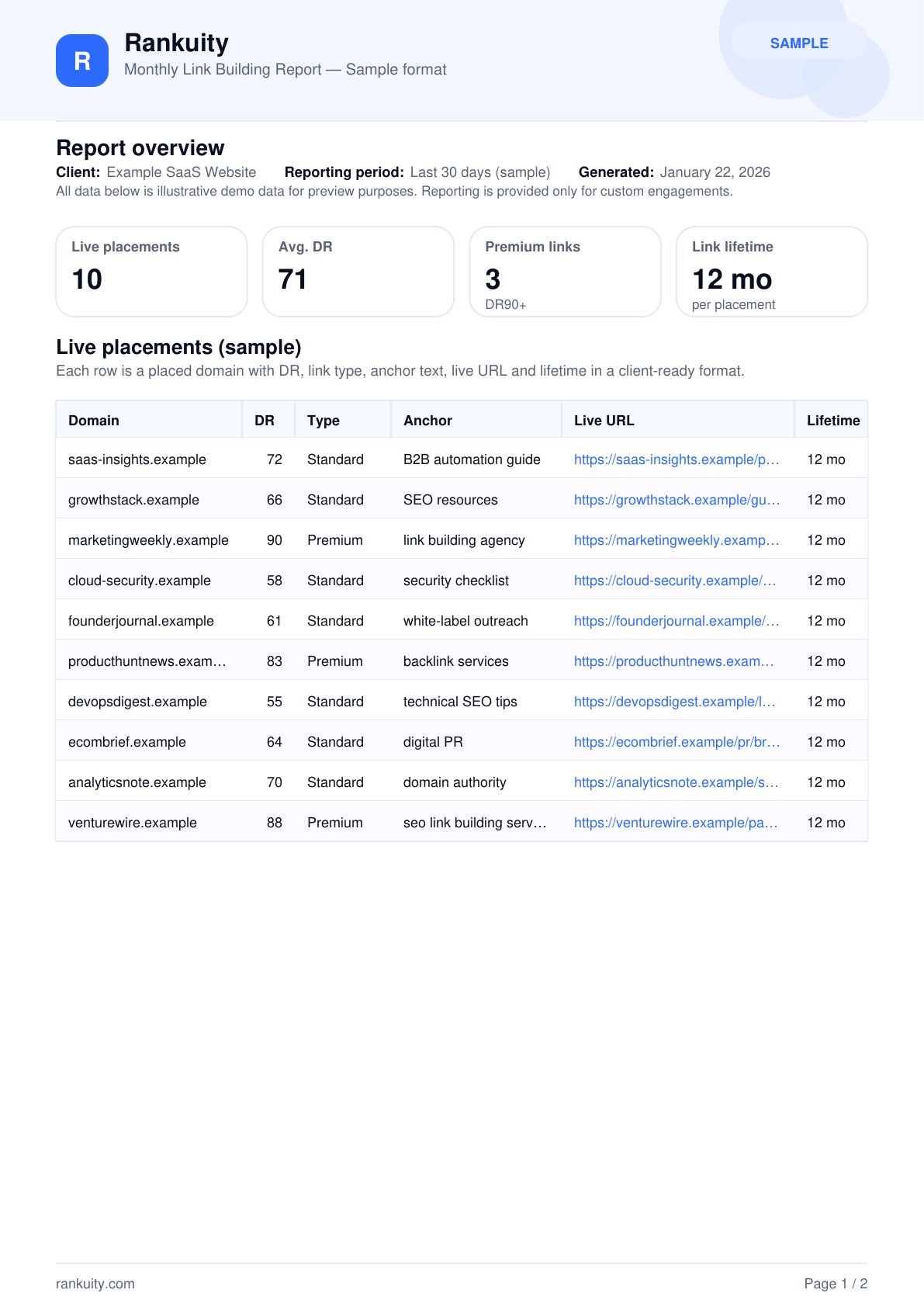
In every report
You will see a clear log of work shipped and a dashboard of outcomes. If we are running link building, the report includes a placement ledger so you can audit every URL.
- Work shipped: fixes, pages, internal links, on-page changes
- Visibility: Search Console coverage, queries, and page movement
- Leads: calls/forms/bookings (where tracking is available)
- Links: monthly placements list + notes and anchors
State hub blueprint (built for unique content)
If you plan to expand across the United States, the fastest way to create a clean structure is to build state hubs first. The key is uniqueness: each state page should reflect real market conditions (competition, SERP features, industries) and include proof modules — not copy‑pasted paragraphs with a different state name.
Market snapshot
What actually ranks in this state.
- SERP layout (ads-heavy, local-heavy, directory-heavy)
- Competitor types: brands vs aggregators vs local лидеры
- Search behavior notes (calls vs forms vs bookings)
Intent map
Service clusters and high‑intent pages.
- Service + state pages (commercial intent first)
- Comparison / alternatives where it makes sense
- FAQ modules based on real pre‑sale questions
Unique content modules
Proof blocks, not filler.
- Mini case snapshots relevant to the vertical
- Reviews/testimonials (when available) + trust signals
- Local compliance notes (industry dependent)
Internal linking logic
Clean crawl paths for Google.
- State hub → services → supporting pages
- Navigation and breadcrumbs that scale
- “Related states” links (smart, not spammy)
State-focused link plan
Relevance-first authority building.
- Local orgs, associations, sponsorships (where relevant)
- Niche resources and editorial mentions
- Documented placements (ledger) for auditability
Reporting by state
Visibility + leads + shipped work.
- Search Console performance segmented by state hubs
- Lead tracking (calls/forms) where available
- Work shipped log + next actions
How we keep state pages unique (no copy‑paste)
If every page looks the same, Google learns it is a template. We design state hubs to read like real landing pages with market nuance.
- Unique intro and value proposition for the state market
- Industry‑specific angles (home services ≠ legal ≠ SaaS)
- Different proof modules: case snapshots, process, objections
- State‑specific link angles and outreach targets
- A clear “next expansion” logic without thin pages
State rollout calculator (quick estimate)
Use this planner to estimate a clean state rollout without creating thin pages. It is not a quote — it is a structure guide we use to keep growth readable for Google and humans.
Inputs
Adjust the sliders and see a recommended rollout approach.
Plan preview
A practical rollout suggestion will appear here based on your selections.
SEO & link building across US states
Below is a directory of US states we support. Click a state on the map (or in the list) to open its hub page. Each link is a future hub you can expand with unique, state-specific content (services, industries, proof blocks) and local market notes. This keeps your structure clean and avoids copy‑pasted pages.
Interactive US state map
Click a state to open its SEO agency hub.
Planning state pages next? We recommend building them as real hubs: local intent map, a location rollout plan, proof blocks, and a link plan. If you want, we can generate a unique outline for each state page so they never look templated.
SEO Agency USA FAQs
Short, practical answers about how we run SEO campaigns in the United States.
Local SEO questions (Google Business Profile, map pack visibility, reviews, and citations).
Do you offer local SEO in the USA?
Yes. For local businesses we focus on Google Business Profile optimization, local landing pages, review strategy, citation consistency, and local links that support map pack visibility. For multi‑location brands, we build scalable architecture (states first) and reporting that stays clean as you expand.
What matters most for Google Maps rankings in US cities?
Local results are influenced by relevance, trust, and consistency. We improve your profile setup (categories, services, photos), keep business info consistent across the web where needed, and help you build review momentum and local authority signals.
How do you handle multi‑location businesses across US states?
We typically start with state hubs, then roll out location pages only where it makes sense — using unique modules so pages don’t look templated. Internal linking and navigation are designed to scale, so Google can crawl and users can find the right location fast.
Can you clean up citations and duplicate listings?
Yes. If citations or duplicate listings are a blocker, we run an audit, fix inconsistencies, and clean duplicates where possible. We only focus on citations that are relevant for your niche and market — not busywork.
National SEO questions (commercial intent, content depth, and competing with large US sites).
How do you approach national SEO in the USA?
We start with commercial intent: the pages that directly drive leads or sales. Then we build topical depth around those pages (clusters, comparisons, FAQs), and support them with technical hygiene and authority building. This is how US sites compete with big directories and established brands.
Do state hub pages help national brands?
Often, yes — especially if demand and competition vary by state. State hubs can clarify relevance and prevent duplicate content when you expand. The key is uniqueness: market notes, proof blocks, and a state‑relevant link angle rather than swapping state names in the same template.
How long does SEO take in competitive US markets?
SEO compounds. Technical fixes can improve crawl and CTR quickly, but content and authority usually take 2–6+ months to show consistent movement. Timing depends on your baseline, the SERP layout, and how strong the competitors are.
Can you work with an in‑house team or an agency partner?
Yes. We can deliver as tickets/PRs with QA notes, or run execution end‑to‑end. If you are an agency, we can operate white‑label with documented deliverables and reporting.
Link building questions (methods, safety guardrails, and transparency).
Are you also a link building agency?
Yes — link building is not an add‑on for us. Rankuity runs dedicated authority programs and backlink acquisition for US markets. You can combine it with full SEO execution or run link building as a standalone engagement. Everything is tracked in a placement ledger.
What link building methods do you use in the USA?
We use relevance‑first methods: niche resources, partnerships, digital PR, unlinked mention reclamation, and state‑relevant angles. The method depends on your industry and what a real editor would consider credible.
Do you buy links?
We do not sell random “link packages”. We focus on legitimate placements and quality control. If a placement is sponsored, it is handled as sponsored. We keep a placement ledger so you can audit everything.
How do you report links and link quality?
Every month you receive a documented placements list (URLs + context notes). We also track whether links support priority pages and whether those pages gain visibility and leads. Link building should connect to outcomes, not just a count of URLs.
SEO + Ads questions (shared landing pages, intent validation, and measurement).
Can you align SEO with Google Ads in the USA?
Yes. We use paid search data to validate intent, shape landing pages, and prioritize content. SEO and PPC work best together when tracking, page messaging, and conversion goals are shared.
How do you use PPC data for SEO decisions?
PPC reveals what converts: which offers, which wording, which queries generate qualified leads. We use that information to improve titles and on‑page messaging, build comparison pages, and prioritize the pages most likely to drive revenue in the US market.
Do you build landing pages for both SEO and ads?
Yes. Sometimes the best approach is a shared high‑intent page that works for both channels. In other cases we split pages by intent so ads can stay tightly focused while SEO captures broader demand. Either way, we optimize for clarity and conversion — not for “SEO word count”.
What do you need to start and how do you measure success?
To start: your website URL, target states, priority services/products, and access to Search Console/analytics if available. We measure success with outcomes (calls, forms, bookings, revenue signals) and show a work log so progress is explainable.
Want a US-specific SEO plan?
Tell us your industry and target state list (and priority markets, if relevant) — we will outline the first actions that usually unlock movement: technical fixes, high-intent pages, and a clean link plan.